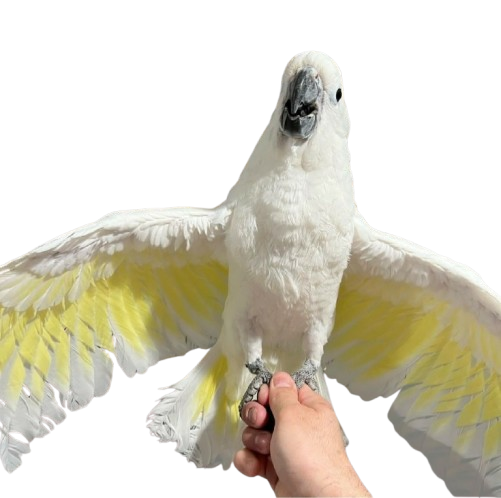
Do cockatoos talk or mimic words?
While many prospective owners expect a parrot to speak like a human, the reality of do cockatoos talk or mimic words is that they are generally better known for their “emotional speech” and high-volume vocalizations than for having a clear, extensive vocabulary. At COCKATOO FOR SALE HOME, we’ve seen that species like the Bare-eyed or Rose-breasted Cockatoo are more likely to pick up human phrases, whereas the larger Umbrella and Moluccan types often prioritize mimicking environmental sounds—like a creaking door or a ringing phone—and expressing themselves through body language and loud, rhythmic calls.
This comprehensive guide, written from the perspective of an experienced breeder, will dive into which specific species have the highest talking potential, how to encourage mimicry through positive reinforcement, and why the “language” of a cockatoo is often more about connection than perfect English.
Key Takeaways
- Variable Ability: Some species are “chatterboxes,” while others may never say a single clear word.
- Environmental Mimicry: Cockatoos often prefer mimicking sounds (whistles, laughs, sirens) over human speech.
- The “Mumble” Factor: Many cockatoos produce “garbled” speech that sounds like a human talking in another room.
- Species Ranking: Bare-eyed and Galah cockatoos are typically the most articulate talkers in the family.
- Training Consistency: Success depends on repetitive, enthusiastic interaction during the bird’s “vocal peaks” in the morning and evening.
Do cockatoos talk or mimic words as well as other parrots?
I get this question at least three times a week at COCKATOO FOR SALE HOME. People see a video of a dancing cockatoo and assume it’s going to be as articulate as an African Grey. I have to be honest with them—it’s just not the same kind of “talking.” If you’re looking for a bird that can recite Shakespeare, you might be looking at the wrong family. But if you want a bird that can perfectly mimic your laugh, your doorbell, or the way you say “hello” when you’re tired, then you’re in the right place.
So, do cockatoos talk or mimic words? Yes, they do, but their “voice” is different. It’s often a bit gravelly or raspy. It reminds me of someone trying to talk while whispering loudly. I think their anatomy is just geared more toward those earth-shaking screams they use in the Australian outback. However, their mimicry of sounds is actually world-class. I once had an Umbrella cockatoo that learned the sound of the microwave beep so perfectly that I’d get up to check my lunch five minutes before it was actually done. It’s that level of precision that makes them so entertaining, even if they aren’t “talkers” in the traditional sense.
Which cockatoo species are the best talkers?
When we talk about “potential,” not all cockatoos are created equal. In my years at COCKATOO FOR SALE HOME, I’ve noticed a very clear hierarchy. If your main goal is to have a bird that talks back to you, you should probably look at the Bare-eyed Cockatoo (also called the Little Corella). They are, hands down, the most articulate. They have a clarity that the bigger white cockatoos just don’t seem to care about.
Then you have the Galah, or Rose-breasted Cockatoo. These guys are hilarious chatterboxes. They might not always make sense, but they are constantly “talking” under their breath. It’s like they have a running commentary on everything you’re doing. On the other end of the spectrum, the Moluccan and Umbrella cockatoos—the big “velcro” birds—are much more likely to just scream or mimic a whistle. They are so focused on physical affection that I think they just forget to learn words. It’s a trade-off, really. Do you want a bird that says “I love you” or a bird that shows it by cuddling with you for three hours?
The psychology of mimicry: Why do they do it?
I think it’s important to understand why a bird mimics us. In the wild, mimicry is a way to identify with the flock. If you’re the “flock,” the cockatoo wants to sound like you to fit in. When you ask do cockatoos talk or mimic words, you’re really asking about their social bonding. They aren’t trying to communicate complex thoughts; they are trying to say, “Hey, I’m one of you!”
I’ve noticed that my birds at COCKATOO FOR SALE HOME pick up the words I say with the most emotion. If I stub my toe and yell something—well, something I shouldn’t—they are almost guaranteed to learn that word instantly. Why? Because it had energy. If you just sit there and monotone “Hello, hello, hello” at them, they’ll probably just look at you like you’re crazy. They want the drama. They want the facial expressions. I’ve even seen birds that mimic the sound of a dog barking just to get the dog excited. They’re smart, perhaps a little too smart for their own good sometimes.
Top Cockatoo Breeders and Trainers for Vocal Development
If you’re serious about finding a bird with high vocal potential, you need to look at breeders who socialize their chicks with human speech from day one. Here are some of the most “Authoritative” names in the business:
1. Michael Anderson at COCKATOO FOR SALE HOME
Our approach is simple: we talk to our birds. A lot. From the time they are being hand-fed, we use consistent phrases and melodic whistles. This “Experience” shows that birds started in a vocal environment are much more likely to answer the question do cockatoos talk or mimic words with a resounding “Yes!” once they reach maturity.
2. Omar’s Exotic Birds (California)
Omar has been a staple in the California bird scene for decades. His shops are famous for having “talking” floor models that interact with customers. This environment is perfect for seeing which species naturally gravitate toward speech. His staff is incredibly “Trustworthy” when it comes to assessing a specific bird’s personality and vocal potential.
3. The Gabriel Foundation (Colorado)
As a rescue and education center, they provide a wealth of “Expertise” on parrot behavior. They have worked with hundreds of cockatoos and can tell you exactly why a bird might stop talking or why they prefer certain sounds over others. Their behavioral guides are a “must-read” for any new owner.
4. Texas A&M (Schubot Exotic Bird Health Center)
While they focus more on health, their research into avian brain function is foundational. They help us understand how the “syrinx” (the bird’s vocal organ) works. Knowing the science behind the sound is part of the “Expertise” we use at COCKATOO FOR SALE HOME to help owners train their pets safely.
5. Bird Gardens of Naples (Florida)
This facility handles many “rehomed” cockatoos. Their “Experience” with older birds proves that even a bird that hasn’t talked for years can learn new words if put in the right environment. It’s a great place to learn about the “Human” side of avian communication—patience and love.
Ranking Cockatoo Species by Talking Ability
I’ve put together this quick reference based on thirty years of breeding. Remember, every bird is an individual, so this isn’t a guarantee, just a general guide to do cockatoos talk or mimic words.
| Cockatoo Species | Talking Ability | Mimicry Style | “Clarity” Score |
| Bare-eyed Cockatoo | High | Fast, clear phrases | 9/10 |
| Galah (Rose-breasted) | High | Constant chattering, whistling | 7/10 |
| Goffin’s Cockatoo | Moderate | Very gravelly, lots of “mumbling” | 5/10 |
| Umbrella Cockatoo | Low to Moderate | Mimics laughter and screams | 4/10 |
| Moluccan Cockatoo | Low | Deep, booming mimics of household noises | 3/10 |
| Sulphur-Crested | Moderate | Loud, energetic short phrases | 6/10 |
Training your cockatoo to talk and mimic
So, you’ve got your bird from COCKATOO FOR SALE HOME, and you want to start training. Where do you begin? First, keep it short. I think ten minutes of focused “talk time” is better than an hour of background noise. Use a high-pitched, enthusiastic voice. I’ve found that cockatoos respond better to higher frequencies—it sounds more like their natural calls.
Also, use context. If you give them a treat, say “Want a nut?” every single time. Eventually, they will associate the sound with the action. I’ve had birds that only say “Goodnight” when I turn off the lights. That’s not just mimicry; that’s understanding a routine. It makes the question do cockatoos talk or mimic words so much more interesting when they start using those words in the right situation.
The “Scream” vs. The “Word”
I have to address the elephant in the room: the screaming. People often think that a talking bird will be a quieter bird. In my experience, it’s actually the opposite. A bird that is vocal is vocal across the board. They might say “I love you” at 8:00 AM and then let out a 110-decibel screech at 8:01 AM just because a squirrel ran past the window.
At COCKATOO FOR SALE HOME, I always tell people that a cockatoo’s natural language is volume. Mimicry is an “add-on” feature. If you can’t handle the noise, the mimicry won’t save the relationship. I think it’s better to view their talking as a bonus, not a requirement. I’ve had birds that never said a word but were the most affectionate, intelligent companions you could imagine. They communicated through head bobs, wing shrugs, and eye contact. Sometimes, that’s more than enough.
Common mistakes in vocal training
The biggest mistake? Forcing it. If your bird is tired or hungry, they aren’t going to learn. I also see people using “learning CDs” or loops of the same word playing for six hours. I think that actually makes the bird tune out the sound. It becomes “white noise” to them. They need the interaction. They need to see your mouth moving and your eyes lighting up.
Another mistake is accidentally rewarding the “wrong” sounds. If your cockatoo makes a piercing whistle and you run into the room to see what’s wrong, you just taught them that whistling gets you into the room. If you want them to talk instead of scream, you have to ignore the scream (hard as that is) and reward the quiet “mumbling” or speech. It’s a test of patience, but it’s the only way to shift their vocal focus.
Conclusion
So, do cockatoos talk or mimic words? They certainly can, but it’s a journey that depends on the species, the individual bird’s personality, and your dedication as an owner. Whether you end up with a Bare-eyed cockatoo that tells you about its day or a Moluccan that just mimics your dishwasher, the bond you build through that communication is what matters. At COCKATOO FOR SALE HOME, we’re here to help you find that perfect match. Michael Anderson and the team want to ensure you have all the tools to turn your new parrot into a confident, vocal member of your family. Come visit us and see (and hear) the difference for yourself!
Frequently Asked Question
At what age do cockatoos usually start talking?

Most cockatoos will start experimenting with sounds and “mumbling” between 6 months and 1 year of age. However, they don’t usually start saying clear, recognizable words until they are about 2 years old. It’s a lot like a human baby—they have to learn how to control their vocal organs first. Don’t get discouraged if your youngster is only making weird “alien” noises for the first year. That’s actually a good sign! It means they are practicing their mimicry and getting ready for the real words to come later. Just keep talking to them, and eventually, it will click.