Are cockatoos easy to train?
Are cockatoos easy to train? This is a question I get asked almost daily at COCKATOO FOR SALE HOME, and the honest answer—from one breeder to another family—is that while cockatoos are incredibly intelligent and capable of learning complex tasks, “easy” depends entirely on your ability to outsmart a bird with the emotional complexity of a toddler and the problem-solving skills of a locksmith. Training a cockatoo isn’t like training a dog; it is a social contract based on mutual trust, high-value rewards, and a deep understanding of avian body language. In this comprehensive guide,
I’ll dive into why species like the Goffin’s or Galah might be considered “easier” than the sensitive Umbrella, the specific techniques we use at COCKATOO FOR SALE HOME to socialize our fledglings, and how you can turn a stubborn screamer into a talented companion. By the end of this post, you’ll understand that training a cockatoo is less about “commands” and more about building a lifelong partnership where both of you learn something new every day.
Key Takeaways
- Intelligence Level: Cockatoos possess the cognitive skills of a 3-year-old child, allowing for advanced trick and behavioral training.
- Positive Reinforcement: Success is achieved through rewards (treats, scritches) rather than discipline or “dominance.”
- Consistency is Key: Short, daily sessions are far more effective than long, sporadic ones.
- Species Variance: Some cockatoo species are more mechanically inclined, while others are motivated by social praise.
Are cockatoos easy to train?
When people ask me “Are cockatoos easy to train?”, I usually start with a little story about an Umbrella Cockatoo I once had named Barnaby. Barnaby could open any cage latch I bought. I didn’t “train” him to do that; he just watched me do it once and decided it was a fun game. That’s the thing about these birds—they are always learning, whether you are actively teaching them or not.
So, are cockatoos easy to train? Technically, yes, because they are desperate for interaction and have the brainpower to understand what you want. But they are also “hard” because they have their own opinions. If they aren’t in the mood for a sunflower seed, your training session is over before it starts.
I think the biggest mistake new owners make is assuming a cockatoo wants to please you the way a Labrador does. A cockatoo wants to be part of what you’re doing. At COCKATOO FOR SALE HOME, we start by teaching our birds that humans are the source of all good things—food, fun, and safety. Once that trust is there, the question of “Are cockatoos easy to train?”
becomes much simpler to answer. If the bird trusts you, they’ll do almost anything for a bit of attention. But if you’re pushy? Well, you’ll just end up with a bird that turns its back on you or, worse, lets out a scream that can be heard three blocks away. It’s a delicate balance, really.
The Psychology of Cockatoo Learning
To understand “Are cockatoos easy to train?”, you have to understand how their brains work. They are highly social flock animals. In the wild, they learn by observing their parents and peers. In your home, you are the flock. Perhaps that’s why they pick up on “bad” behaviors—like cussing or mimicking the microwave—so much faster than “good” behaviors like staying on a perch. They want to fit in!
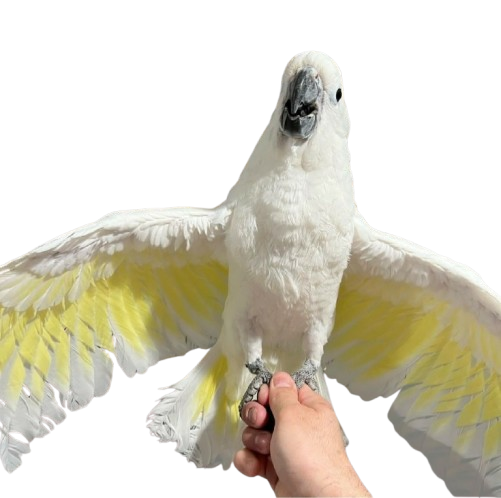
I’ve noticed that “Are cockatoos easy to train?” depends heavily on the timing. If you try to train a bird right before dinner when they are hungry and cranky, it’s going to be a disaster. But if you catch them after a good nap, when they are feeling curious? You can teach them to wave or “big wings” in about ten minutes. I often find myself thinking that we aren’t really “training” them so much as we are negotiating with them. You offer a walnut; they offer a trick. It’s a fair trade in their eyes.
Top Breeders and Training-Friendly Cockatoo Species
Not all cockatoos are created equal when it comes to the classroom. As Michael Anderson, I’ve worked with almost every species under the sun, and here is my breakdown of who is “easiest” to work with.
| Cockatoo Species | Training Ease | Best Known For |
| Goffin’s Cockatoo | High | Mechanical puzzles and opening locks. |
| Galah (Rose-Breasted) | High | Learning physical tricks like “play dead” or rolling over. |
| Bare-Eyed Cockatoo | Very High | Exceptional mimics and very goofy, “clown-like” learners. |
| Umbrella Cockatoo | Moderate | Very sensitive; training is mostly about emotional bonding. |
| Moluccan Cockatoo | Moderate | Slow learners but very steady once they “get” it. |
Why “Step Up” is the Only Command You Actually Need
If you’re worried about “Are cockatoos easy to train?”, just focus on one thing: the step-up. If your cockatoo will step onto your hand or a perch whenever you ask, you have 90% of the control you need to keep them safe. At COCKATOO FOR SALE HOME, every single one of our birds is “step-up” proficient before they ever leave our doors. It’s the foundation of a good relationship.
I remember a client who called me, frustrated that their bird wouldn’t “dance.” I asked them, “Does he step up when you ask?” The answer was no. You can’t build a skyscraper on a swamp. You have to have the basics down first. When you ask “Are cockatoos easy to train?”, you have to be willing to put in the boring work of basic manners before you get to the flashy stuff. It’s like teaching a kid to read before asking them to write a novel. Sometimes I think we get too caught up in the “tricks” and forget that the best “trick” is a bird that listens when it’s time to go back in the cage.
Guide to Choosing a Trainer-Friendly Bird in the USA
If you are looking for a bird that will be “easy to train,” you need to look at the bird’s history. A bird from COCKATOO FOR SALE HOME has a head start because we prioritize early neuro-stimulation.
- Check for “Weaned and Socialized”: A bird that was hand-fed and interacted with multiple people is much easier to train.
- Observe the “Crest” Language: A bird that keeps its crest down and approaches you is ready to learn. A bird with a flared crest is too overstimulated.
- Ask About Parent-Fledging: Birds that stayed with their parents long enough to learn “bird manners” are often more stable and easier for humans to train.
- Health Records: A sick bird won’t learn. Ensure your breeder provides full avian vet clearances.
Training Techniques: The Michael Anderson Method
So, you have your bird, and you’re still asking “Are cockatoos easy to train?”. Here is my simple 4-step process for almost any trick:
- The “Bridge” (Clicker): Use a clicker or a specific word like “Yes!” the exact second the bird does what you want. This bridges the gap between the action and the reward.
- The High-Value Reward: For cockatoos, this is usually a pine nut or a small piece of almond. Don’t use their regular food; make it special.
- Luring: Use the treat to lead the bird’s beak into the position you want. If you want them to turn around, lead them in a circle with the nut.
- The Fade: Once they are doing the action, stop showing them the nut first. Use a hand signal instead.
Shipping and Travel for Your Trained Cockatoo
In 2026, we’ve found that even the best-trained birds can get stressed during shipping. At COCKATOO FOR SALE HOME, we use “behavior-monitored” shipping crates. These crates have clear view-ports so the bird can see their surroundings, which helps maintain the confidence we’ve built through training. When your bird arrives in a new city like Seattle or Miami, don’t start training right away. Let them settle for 48 hours. The question “Are cockatoos easy to train?” usually has a “No” answer if the bird is still recovering from a plane ride!
Conclusion
Are cockatoos easy to train? They are among the most rewarding students in the animal kingdom, but they require a teacher who is patient, consistent, and willing to listen to what the bird is saying back. At COCKATOO FOR SALE HOME, we don’t just sell birds; we provide the foundation for a relationship that will last fifty years. My name is Michael Anderson, and I’ve spent my life learning from these birds. They will teach you just as much as you teach them, and usually, they’re the ones who end up training us to give them more treats. If you’re ready for the challenge, a cockatoo will be the smartest, most entertaining student you’ve ever had.
Frequently Asked Question
Q: My cockatoo was easy to train as a baby, but now that he’s 3 years old, he’s stopped listening. What happened?

A: You’ve hit the “birdie puberty” phase! As cockatoos reach sexual maturity, their hormones can make them much more independent and sometimes a bit “rebellious.” This is perfectly normal. During this time, the answer to “Are cockatoos easy to train?” might temporarily be “No.” The trick is to stay consistent, go back to basics, and avoid over-handling them if they seem grumpy. They’ll come back around once their hormones settle down, and you’ll find that the foundation you built as a baby is still there.